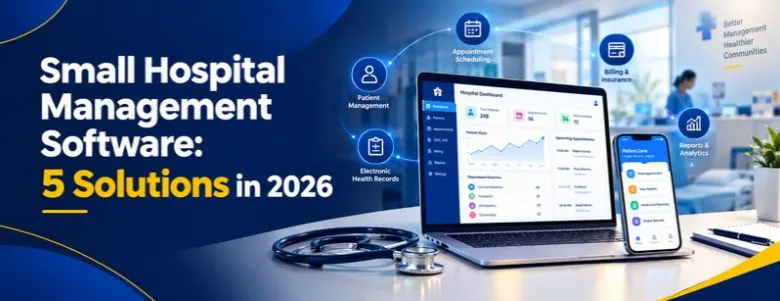
Running a small hospital involves many of the same challenges as a large healthcare facility, but with fewer staff, tighter budgets, and simpler operational requirements. This is why small hospital management software should be easy to use, affordable, scalable, and capable of handling essential hospital workflows without unnecessary complexity.
A modern hospital management system for small hospitals can bring patient registration, OPD, IPD, billing, electronic medical records, pharmacy, laboratory services, appointments, and reporting into one digital platform.
In this guide, we look at 5 hospital management software solutions that small hospitals, nursing homes, and growing healthcare facilities can consider in 2026.
Small hospital management software helps smaller healthcare facilities manage patient registration, OPD, IPD, billing, medical records, pharmacy, laboratory services, appointments, and reporting from one system. Options such as OpdNest, Practo Ray, MocDoc, Bahmni, and NextGen eHospital offer different combinations of cloud, open-source, clinical, administrative, and hospital-management capabilities. The right solution depends on the hospital’s size, workflow, budget, deployment requirements, integrations, and future growth plans
Table of Contents
- What Is Small Hospital Management Software?
- 5 Small Hospital Management Software Solutions
- Comparison of Small Hospital Management Software
- Important Features to Look For
- Cloud vs. On-Premise Hospital Software
- How Much Does It Cost?
- How to Choose the Right System
- Small Hospital Software vs. Enterprise HMS
- Can Small Hospitals Use Custom Software?
- Why Choose WebGi Solutions for Custom HMS Development
- Frequently Asked Questions
- Final Checklist
- Final Thoughts
What Is Small Hospital Management Software?
Running a small hospital involves many of the same challenges as a large healthcare facility, but with fewer staff, tighter budgets, and simpler operational requirements. This is why small hospital management software should be easy to use, affordable, scalable, and capable of handling essential hospital workflows without unnecessary complexity.
A modern hospital management system for small hospitals can bring patient registration, OPD, IPD, billing, electronic medical records, pharmacy, laboratory services, appointments, and reporting into one digital platform.
Unlike large enterprise hospital information systems, software for a small hospital generally focuses on the workflows the facility actually needs, such as:
- Patient registration
- OPD management
- IPD and admission management
- Appointment scheduling
- Doctor and staff management
- Electronic medical records
- Digital prescriptions
- Billing and invoicing
- Pharmacy and inventory
- Laboratory management
- Patient communication
- Reports and dashboards
For a 10-, 20-, 50-, or 100-bed facility, choosing a system that matches the hospital’s actual workflow can be more practical than paying for a large number of unused enterprise modules. If your organization is comparing several types of operational software at once, our Top 10 CRM for Small Business guide and our 25 Best Fleet Management Software guide use the same side-by-side comparison approach.
5 Small Hospital Management Software Solutions to Consider in 2026
1. OpdNest
OpdNest is a hospital management platform positioned for small hospitals, nursing homes, and multi-specialty clinics in India. Its listed functionality includes OPD management, patient records, billing, pharmacy, inventory, digital prescriptions, and appointment communication.
The platform also lists support for ABHA, CGHS and PM-JAY-related workflows, along with WhatsApp and SMS appointment reminders.
Key features include:
- OPD registration and queue management
- Patient records and EMR/EHR
- Hospital billing and invoicing
- Pharmacy and inventory management
- Digital prescriptions
- Appointment scheduling
- Patient communication
- Multi-doctor and multi-department management
Best suited for: Small hospitals, nursing homes, and healthcare facilities looking for an India-focused cloud hospital management system.
2. Practo Ray
Practo Ray is a practice management platform from Practo that provides appointment management, patient records, billing, prescriptions, communications, and reporting features.
Practo states that Ray is used by more than 50,000 doctors and supports digital patient records, appointment reminders, online payments, and patient communication.
Its current platform also provides access to patient information, billing, communications, reports, appointments, and back-office functions such as inventory and expenses.
Key features include:
- Appointment scheduling
- Patient records
- EMR
- Digital prescriptions
- Billing and invoices
- Appointment reminders
- Patient communication
- Reports
- Inventory and expense management
- Mobile access
Best suited for: Smaller healthcare practices and facilities that need a combination of practice management and patient engagement features.
3. MocDoc
MocDoc provides cloud-based hospital, clinic, and laboratory management software for healthcare organizations in India. Its platform includes hospital and lab management capabilities and is positioned for facilities ranging from clinics to hospitals and diagnostic organizations.
MocDoc highlights cloud deployment, multilingual support, and healthcare-specific capabilities for the Indian market.
Key features include:
- Hospital management
- Clinic management
- Laboratory management
- Cloud access
- Patient management
- Billing
- Inventory
- Pharmacy workflows
- Multilingual support
- Healthcare administration
Best suited for: Small and growing hospitals that may need to expand from basic hospital administration into laboratory, pharmacy, and other healthcare workflows.
4. Bahmni
Bahmni is an open-source electronic medical record and hospital information system designed particularly for healthcare environments where affordability, flexibility, and local deployment are important.
Its official feature list includes patient registration, clinical services, laboratory management, inpatient management, stock management, billing, accounting, and reporting.
Bahmni combines several open-source healthcare systems, including OpenMRS for medical records and patient management, alongside systems for inventory, billing, accounting, laboratory management, and imaging.
Key features include:
- Patient registration
- Electronic medical records
- Clinical documentation
- Inpatient management
- Bed assignment
- Laboratory management
- Pharmacy and stock management
- Billing and accounting
- Reporting
- Local hosting options
Best suited for: Healthcare organizations looking for an open-source or highly adaptable hospital information system.
5. NextGen eHospital
NextGen eHospital is a hospital management information system developed by India’s National Informatics Centre (NIC). It is designed to digitize hospital workflows and is offered as a cloud-based, configurable system.
The system includes patient registration, appointments, OPD, IPD, EHR, billing, laboratory, radiology, pharmacy, stores and inventory, and operation theatre modules.
NIC also states that the platform is integrated with the Ayushman Bharat Digital Mission ecosystem and supports healthcare standards including DICOM, LOINC, SNOMED CT, FHIR, and ICD-10.
Key features include:
- Patient registration
- OPD management
- IPD management
- EHR
- Appointment management
- Billing
- Laboratory
- Radiology
- Pharmacy and inventory
- Operation theatre management
- ABDM-related integration
- Healthcare interoperability standards
Best suited for: Hospitals and healthcare facilities looking for a comprehensive HMIS with broad hospital workflow coverage.
Comparison of Small Hospital Management Software
| Software | Best suited for | Deployment | Key strengths |
|---|---|---|---|
| OpdNest | Small hospitals and nursing homes | Cloud | OPD, records, billing, pharmacy |
| Practo Ray | Clinics and smaller practices | Cloud | Appointments, EMR, billing, communication |
| MocDoc | Hospitals, clinics and labs | Cloud | Hospital + laboratory workflows |
| Bahmni | Flexible/open-source healthcare environments | Local/appropriate infrastructure | EMR, inpatient, lab, pharmacy, billing |
| NextGen eHospital | Hospitals and public healthcare facilities | Cloud | Comprehensive HMIS and interoperability |
Important Features to Look for in Software for a Small Hospital
Choosing hospital management software for a small hospital is not simply about finding the platform with the largest feature list. The system should support the hospital’s daily workflow without creating unnecessary complexity.
1. Patient Registration
The software should make it easy for reception staff to register new patients, search existing records, manage appointments, and avoid duplicate patient profiles.
2. OPD Management
For hospitals with busy outpatient departments, the system should support doctor schedules, patient queues, consultations, prescriptions, and visit records.
3. IPD Management
If the hospital provides inpatient services, look for admission, discharge, transfer, bed allocation, and ward-management capabilities.
4. Electronic Medical Records
An EMR system for small hospitals can help healthcare teams maintain patient histories, consultation notes, prescriptions, investigation results, and other clinical information digitally.
5. Billing and Payments
Hospital billing software should make it easier to manage consultation charges, procedures, pharmacy charges, investigations, discounts, receipts, and other payments. For Indian hospitals, it is also useful to check whether the system supports the hospital’s required GST and payment workflows.
6. Pharmacy and Inventory
A small hospital may benefit from software that tracks medicines, stock levels, batches, expiry dates, purchases, and dispensing.
7. Laboratory Management
If the hospital operates its own laboratory, an integrated laboratory module can reduce manual data entry and make investigation orders and reports easier to manage.
8. Reporting and Analytics
Hospital administrators should be able to monitor information such as patient volumes, revenue, billing, appointments, inventory, and other operational metrics.
9. Data Security and Access Control
Healthcare software handles sensitive patient information. Before selecting a platform, hospitals should review its security controls, user permissions, backups, audit capabilities, data retention policies, and applicable compliance requirements.
10. Scalability
A small hospital may start with OPD, billing, and patient records and later add pharmacy, laboratory, IPD, or additional departments. A modular hospital information system for small hospitals can therefore be useful when the facility expects to grow.
Cloud vs. On-Premise Hospital Software
Small hospitals often have to decide between cloud-based and locally hosted hospital software.
Cloud Hospital Management Software
Cloud software can provide:
- Remote access
- Vendor-managed infrastructure
- Automatic software updates
- Reduced server maintenance
- Easier scalability
- Lower upfront infrastructure requirements
On-Premise Hospital Software
On-premise deployment may be preferred when a facility requires greater control over its local infrastructure or has specific operational and data requirements.
How Much Does Small Hospital Management Software Cost?
The cost of small hospital management software can vary significantly depending on the number of users, beds, departments, modules, deployment model, integrations, implementation services, and support.
Instead of comparing only the subscription price, consider the total cost of ownership:
Some cloud platforms use subscription pricing, while open-source systems can have different costs associated with implementation, customization, hosting, and support.
How to Choose the Right Small Hospital Management System
Before purchasing a small hospital management system, create a list of the workflows that need to be digitized. A practical evaluation checklist includes:
- How many beds does the hospital have?
- How many doctors and staff will use the system?
- Does the hospital need OPD and IPD management?
- Is pharmacy management required?
- Does the hospital operate a laboratory?
- Is EMR/EHR functionality required?
- Does the software support the hospital’s billing requirements?
- Is cloud or on-premise deployment preferred?
- Can the hospital export its data if it changes vendors?
- What training and technical support are included?
- Can additional modules be added as the hospital grows?
- What security and backup controls are provided?
Small Hospital Management Software vs. Enterprise HMS
A small hospital does not necessarily need the same system as a large hospital chain.
A smaller facility may prioritize:
- Simple user interface
- Quick implementation
- OPD and IPD management
- Billing
- Patient records
- Pharmacy
- Laboratory
- Affordable pricing
- Easy staff training
Large hospitals may require much deeper functionality across multiple departments, locations, insurance workflows, advanced analytics, HR, finance, and complex integrations.
Can Small Hospitals Use Custom Hospital Management Software?
Yes. Off-the-shelf software can be suitable for hospitals with standard workflows, but some facilities require customized functionality.
For example, a hospital may need:
- Custom patient workflows
- Specialty-specific modules
- Custom dashboards
- Hospital ERP integration
- Custom mobile applications
- Healthcare AI solutions
- Telemedicine functionality
- Custom patient portals
- Third-party laboratory integrations
- Pharmacy or inventory integrations
- Custom reporting
In these situations, custom hospital management software development can provide greater control over workflows and integrations. For hospitals that need a system designed around their specific processes, a healthcare software development company can evaluate the requirements and build a customized solution rather than forcing the hospital to adapt every workflow to an existing product.
Why Choose WebGi Solutions for Custom Hospital Management Software Development?
If you are looking for a prebuilt hospital management system, WebGi Solutions is not presented as a replacement for OpdNest, Practo Ray, MocDoc, Bahmni, or NextGen eHospital.
That distinction matters. WebGi Solutions can instead help hospitals and clinics that want to build a system around their own specific workflow.
A custom hospital software project can be planned around requirements such as:
- Patient registration and OPD/IPD workflows
- Electronic medical records
- Billing and invoicing
- Pharmacy and inventory management
- Laboratory and radiology workflows
- Role-based staff access
- Custom dashboards and reporting
- Appointment and patient communication tools
- Patient portals
- Telemedicine functionality
- Third-party lab and insurance integrations
- Mobile-friendly interfaces
- AI-powered clinical and administrative features
The starting point should not be “What features can we put into the system?” It should be:
That approach helps prevent hospitals from paying for unnecessary modules.
Frequently Asked Questions
What is small hospital management software?
Small hospital management software is a digital platform designed to manage essential hospital workflows such as patient registration, OPD, IPD, billing, medical records, pharmacy, laboratory services, appointments, and reporting.
What software is used in small hospitals?
Small hospitals can use different types of hospital information systems depending on their requirements. Options include cloud-based HMS platforms, open-source systems, and comprehensive HMIS solutions such as OpdNest, Practo Ray, MocDoc, Bahmni, and NextGen eHospital.
What features should a small hospital management system have?
Important features can include patient registration, appointment scheduling, OPD and IPD management, EMR/EHR, billing, pharmacy, laboratory management, inventory, reporting, user access controls, backups, and integrations.
Is cloud hospital management software suitable for small hospitals?
Cloud-based HMS can be suitable for small hospitals because it can reduce the need for local server infrastructure and provide access to the system from supported locations. However, hospitals should evaluate connectivity, security, backups, support, and data-management requirements before choosing a cloud platform.
Can hospital management software be customized?
Yes. Some hospitals choose custom hospital software development when they need workflows, integrations, dashboards, mobile applications, or healthcare modules that are not available in an off-the-shelf system.
Final Checklist: Choosing Software for Your Small Hospital
Before purchasing, make a simple checklist:
Facility Requirements
- How many beds does the hospital have?
- How many doctors and staff need access?
- Do we need OPD and IPD management?
- What does our patient volume look like?
Features
- Patient registration
- EMR/EHR
- Billing and invoicing
- Pharmacy and inventory
- Laboratory management
- Appointment scheduling
- Reporting and analytics
- Mobile access
Financial
- Subscription or license cost
- Implementation
- Data migration
- Staff training
- Hardware and infrastructure
- Support
Technical
- Cloud vs. on-premise deployment
- Data export
- Security and access control
- Backups
- Integration capability
- Compliance requirements
Future
- Can additional modules be added?
- Can the workflow be customized later?
- Will it work if the hospital adds beds or departments?
- Can data be migrated if we change vendors?
Final Thoughts
The right small hospital management software should make everyday healthcare operations simpler rather than adding unnecessary complexity.
For a small hospital, the most important areas are usually patient registration, OPD and IPD workflows, medical records, billing, pharmacy, laboratory management, reporting, security, and ease of use.
For hospitals focused on OPD and outpatient communication, a platform such as OpdNest or Practo Ray may fit better. Facilities that also run their own laboratory can consider MocDoc. Organizations that want an open-source, highly adaptable system can evaluate Bahmni, while hospitals seeking a comprehensive, government-backed HMIS with broad interoperability can consider NextGen eHospital.
And when a hospital has a workflow that existing HMS software cannot accommodate efficiently, custom hospital management software development becomes another option worth evaluating.
Before selecting a platform, compare the software against your actual hospital workflow, staff requirements, budget, integrations, deployment preferences, and future growth plans. A short practical demo using real-world scenarios can help determine whether the system is genuinely suitable for your facility. If you need a system designed around your own workflow, integrations, or compliance requirements, WebGi Solutions can help you plan and develop a custom hospital management solution rather than forcing your process into an off-the-shelf platform.