When a business notices a drop in SERP rankings, it typically turns to SEO. They tweak their cheap web hosting for WordPress, add keywords, make a new round of content, increase external links, or change the SEO plan they’ve been working with.
Sometimes these changes work. But in the majority of cases the underlying issue lies elsewhere.
Even when a website is hosted by the best hosting companies for WordPress, features top-notch content, and uses the best keywords, it still struggles to gain traction in searches due to technical failures or an undermined user experience. Before search engines’ bots can crawl, index, and render a website, they should access it quickly and efficiently.
In this respect, some problems are rooted in the website itself rather than in the proper use of SEO strategies. Now, let’s take a closer look at these issues.
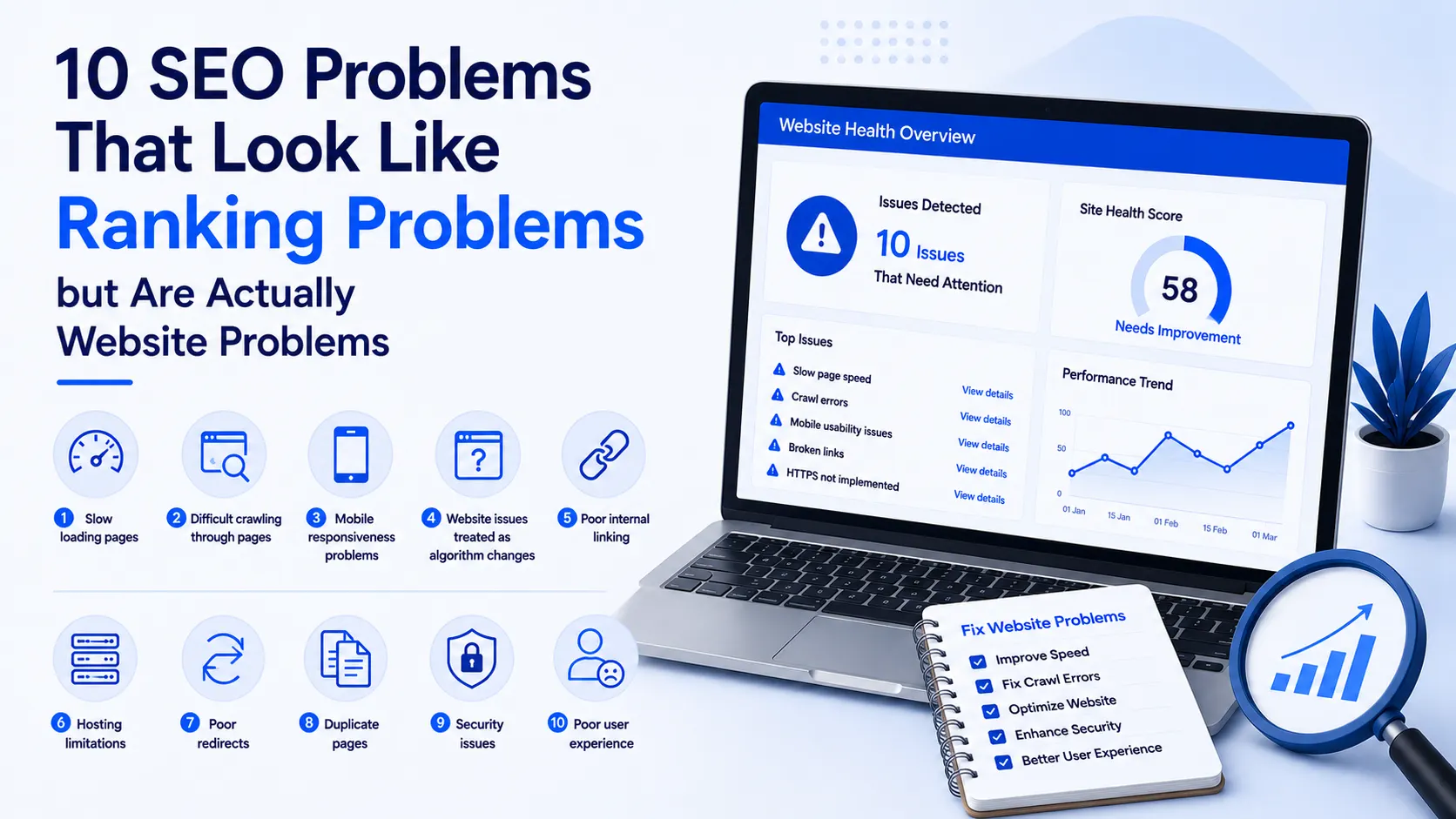
10 Website Glitches That Drain Your Ranking
1. Slow loading pages
Even if a website has excellent content, slow page loading spoils its performance. At such times, users leave the website before receiving any helpful information, especially when using mobile internet connections.
The slow speed loading factors can be multiple: large image sizes, too many scripts, low-quality plugins, delays in the database, or low-level hosting services. Thus, rewriting the content will not solve the genuine problems. Along with checking the keyword usages, it is also important to verify if the website page is fast enough for the users.
2. Difficult crawling through pages
For the search engine to find a page and evaluate it properly, it has to know about it. If a website has complicated navigation, not functional internal linking, wrong redirection, or misconfigured additional technical parameters, it will be impossible for a search engine to find some pages.
A company thinks that the page is poor because its content may not be effective. But the real problem is that a website should be crawled before implementing any new content strategy.
3. Mobile responsiveness problems
A page that is perfectly optimized for desktop may not always work on a smartphone. There could be hard-to-read text, buttons placed too close to each other, images that go off the screen, and long information that requires a lot of scrolling.
Given that a large share of web traffic comes from mobile devices, businesses need to put mobile usability on a par with other considerations. If there are changes in your ranking or organic traffic, analyze the mobile version of the important web pages and see if there are any issues that might be missed in the course of testing the desktop version.
4. Website issues treated as algorithm changes
Companies often assume that fluctuations in rankings are caused by changes in search algorithms. However, it is actually the mistakes on their website that produce similar outcomes. Broken pages, server errors, redirect errors, no index directive used inappropriately, expired SSL certificates, and DNS issues create low traffic results.
5. Poor internal linking
A website consists of various advantageous pages that do not achieve high organic visibility simply due to the poor internal linking with the rest of the website.
The internal links help visitors navigate among relevant pages and enhance the understanding of search engines on how one content piece relates to another. When certain pages are ignored, they might not be getting the attention they require. Often, what the website needs is an upgrade of its informational architecture.
6. Hosting limitations
While hosting doesn’t solely drop the SEO positions, it can greatly affect the efficiency and accessibility of the website.
The lack of sufficient resources and slow server response time make a website inefficient and not reliable at all. These issues become more prominent when the traffic flow increases. If the website fails again and again at times of peak load, producing more content will not solve the problem.
7. Poor redirects
Changing URLs is an element of restructuring a website. Problems arise when the previous URLs are removed without the correct redirects or complex redirecting chains, leading to broken pages for people and search engines unable to identify the original location of the contents.
Thus, the migration or a redesign of a website leads to the illusion of low SEO rankings even when the content remains relevant.
8. Duplicate pages
Large websites accidentally create numerous URLs leading to the same or almost the same content.
The issue with duplicate content is that it makes the process of interpreting the website complicated for search engines. Removing the duplicates and unnecessary URLs helps improve the structure of the website.
9. Security issues
There are many reasons a website loses organic traffic. These include security factors such as malware, hacked pages, spam content, dubious redirects, and warning messages, which all affect the way users and search engines interact with the site.
Security issues may remain undetected for some time. The website may appear completely secure to its owner, but compromised pages or malicious scripts could be operating in the background.
It is vital to monitor security on a regular basis and ensure that the site performs well and search engines accept it.
10. Poor user experience
On some occasions, the content might be right, but the website makes it hard to use. Intermittent pop-up ads, confusing navigation, a huge number of ads, difficult-to-fill-out forms, an unstable layout, and poorly organized pages easily irritate users.
The process of SEO helps bring visitors to the page, and the website plays a role in the next steps taken. If visitors have difficulties, the sole improvement of ranking will not help the business.
Concluding remarks
Remember, not all ranking issues are problems with the SEO strategy. Technical errors such as a slow server, broken redirects, inaccessible pages, mobile usability failures, security breaches, and poor website design can make excellent content not deliver desired results.
Therefore, the most effective SEO approach is focused on issues other than keywords and links. Before revising the content strategy, you need to check the technical part of your website. If the foundation is in excellent shape, it will enable the content to bring more organic traffic to the website.